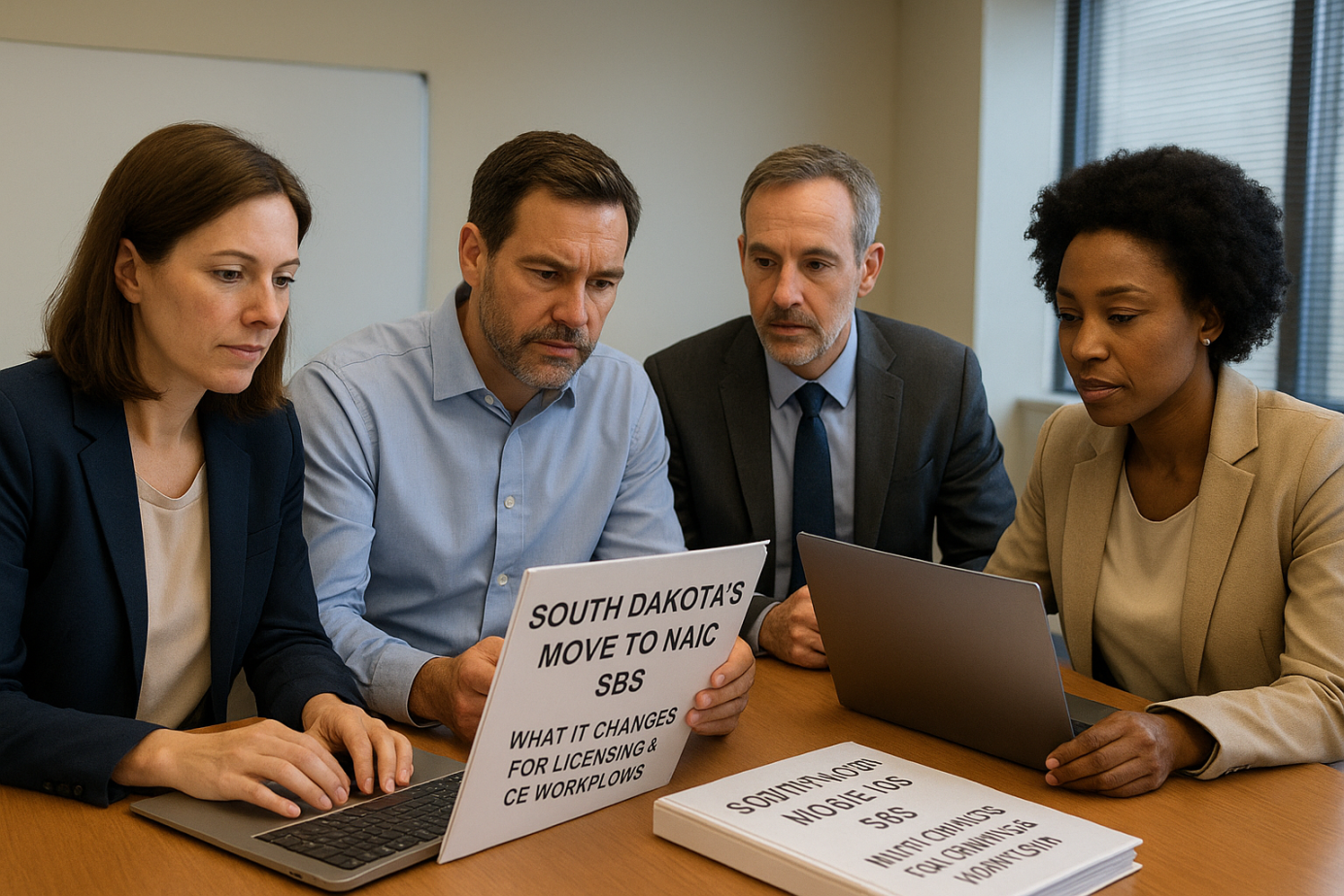
South Dakota’s Division of Insurance has joined a growing list of jurisdictions using NAIC’s State Based Systems (SBS) platform for producer licensing and other regulatory workflows. That sounds like a “back-office” change, but it directly affects how licensing candidates, active producers, and agency compliance teams execute real tasks: applications, renewals, inquiries, complaints, and enforcement-related workflows.
South Dakota adopted SBS—plain-English impact
In a July 16, 2025 NAIC news release (with an earlier original post dated April 17, 2025), the South Dakota Division of Insurance is described as the 36th NAIC member to implement State Based Systems (SBS). SBS is positioned as an electronic platform that helps state insurance departments run producer licensing and other regulatory operations more efficiently while supporting national uniformity initiatives. The release also notes that SBS integrates with the National Insurance Producer Registry (NIPR) to streamline mission-critical tasks.
For South Dakota licensees and candidates, the practical takeaway is simple: expect more of your licensing and compliance “paperwork” to be executed through standardized, system-driven steps, with data flowing between systems (state DOI workflows + NIPR integration) rather than being handled through ad hoc processes.
Training implications: what changes in the day-to-day for licensing and CE
TSI National students and agency teams typically struggle less with “knowing the rule exists” and more with executing the workflow correctly under time pressure. SBS adoption matters because it can change where you complete tasks, what fields you must provide, and how status updates are posted and tracked.
- Licensing candidates: You still need to pass the exam, but you also need a clean, repeatable process for the steps around the exam—application submission, status monitoring, and follow-up requests.
- CE students / active producers: Renewals and compliance tasks are often “simple” until they’re not. System-based workflows tend to make missing items visible faster—helpful, but only if you’re checking your status and records on a schedule.
- Managers / compliance leads: When states standardize workflows, teams should standardize internal controls (who submits what, when status is checked, where confirmations are stored). SBS is a cue to tighten the operational rhythm.
South Dakota Insurance Director Larry Deiter is quoted in the release highlighting improved consumer protection efficiency, ease of use, simpler regulatory work, and potential savings for businesses and license holders, with plans to begin using SBS in the summer. Operationally, that points to a transition period where your team needs a “system change” checklist so licensing and renewal tasks don’t stall mid-cycle.
Manager / Compliance Lead Agenda (this week)
If you supervise producers in South Dakota (or you onboard new hires who will be licensed there), use this headline as a prompt to harden your process. Here’s a practical agenda you can run in 30–45 minutes:
- Map your current workflow: list every step from “candidate starts pre-licensing” to “license issued” to “first renewal,” including who owns each step and where proof is stored (PDF, email, portal screenshot, etc.).
- Define system-of-record rules: decide what your team will treat as authoritative for status checks (state portal/SBS status vs. internal spreadsheet vs. email confirmations). Then document it in one page.
- Set a status-check cadence: pick a simple schedule (e.g., weekly during onboarding; 90/60/30-day checks ahead of renewal windows) so tasks don’t become last-minute emergencies.
- Standardize a “missing info” playbook: create a short internal SOP for what happens when an application/renewal is flagged—who responds, what gets escalated, and what documentation is saved.
- Update onboarding training: add a 10-minute module to your onboarding path: “How our team handles licensing/renewal workflows in South Dakota,” including where producers should look first and what to do if something doesn’t match expectations.
This is also a good moment to ensure your training partner and internal resources are aligned: exam prep is one track; licensing/renewal execution is the second track. Teams that treat them as one integrated workflow reduce compliance surprises.
Candidate study sprint + CE execution focus (next 14 days)
For individual learners, SBS doesn’t change what’s on your exam blueprint—but it can change how smoothly you move from “passed” to “licensed” and from “licensed” to “renewed.” Use this two-week plan to keep both learning and execution tight:
- Days 1–5 (exam readiness): keep your study path simple: concept clarity → focused drills → timed practice tests → miss-log review. Your goal is to reduce content volatility so administrative steps don’t derail your timeline.
- Day 6 (workflow check): write down the exact steps you expect to complete after your exam (application/renewal actions, status check points). If you’re unsure, plan to verify through the South Dakota DOI/NIPR pathway referenced by the NAIC release.
- Days 7–10 (practice-test discipline): run at least two timed sets and do targeted remediation by weak domain. The operational win: fewer retakes means fewer moving parts in the licensing timeline.
- Days 11–14 (CE/renewal habits): even if renewal is far away, set up your habit now: create a folder for confirmations/transcripts, and schedule a recurring reminder to check completion posting and renewal status.
If you’re already licensed and focused on continuing education, treat SBS adoption as a reminder to be proactive: complete CE early enough to allow for posting/processing time, then confirm your records are reflected correctly in the system used for regulatory workflows.
Source-fact recap + the one next step
What we know from the NAIC release: South Dakota is the 36th NAIC member to implement SBS; the release is dated July 16, 2025 and references an earlier April 17, 2025 post; SBS supports licensing and renewals plus inquiries, complaints, and enforcement actions; and SBS integrates with NIPR to streamline critical regulatory tasks. Director Larry Deiter indicated the state planned to begin using SBS in the summer.
Immediate next step: If you’re a candidate, producer, or manager supporting South Dakota licensing/renewals, update your internal checklist this week so your exam prep, licensing execution, and CE/renewal tracking run as one coordinated workflow—and use TSI National’s licensing exam prep and CE planning resources at https://www.tsinational.com/.
Source: Original article
Educational information only; verify requirements with your state Department of Insurance.