
Last reviewed: May 26, 2026. This guide summarizes Louisiana insurance licensing exam pass rates from the workbook source for Calendar year 2024.
Source note: This report compiles information provided by each jurisdiction and/or its designee such as an exam provider. Questions about the data should be directed to the jurisdiction. Data provided is for exams delivered in the English language. Blank cells indicate no data in the workbook.
Quick Takeaways
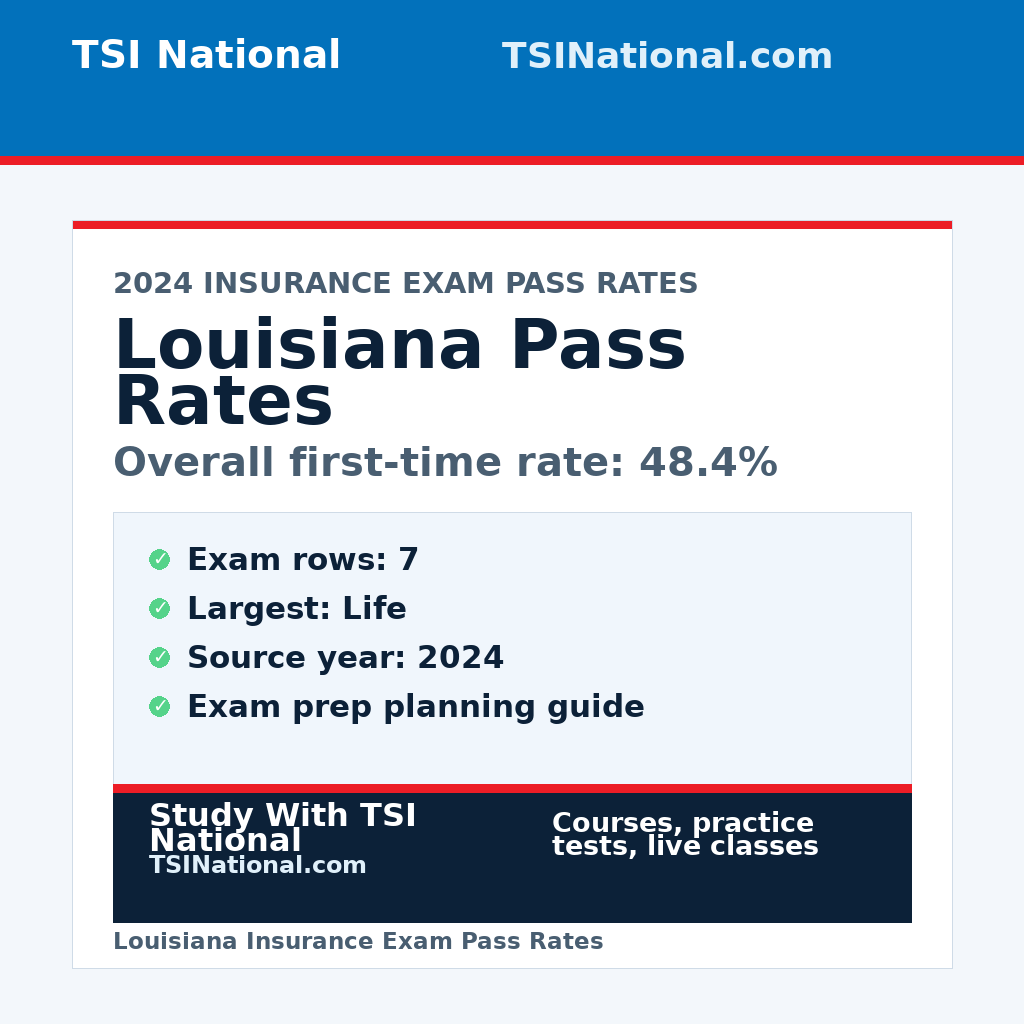
- Overall reported first-time pass rate across the listed Louisiana exam rows: 48.4% across 6,095 first-time test takers.
- Life, Health and Accident or Sickness Insurance Series 103 had a 50.7% combined first-time pass rate across 2,517 reported first-time test takers.
- Highest reported row: Personal Lines (Producer) Series 107 had a 52% combined first-time pass rate across 452 reported first-time test takers.
- Lowest reported row: Casualty Series 105 had a 12.5% combined first-time pass rate across 8 reported first-time test takers.
Louisiana Pass Rates by Exam
The table separates in-person and remote delivery when the workbook reported both. The combined rate is calculated from first-time passers divided by first-time test takers across available delivery modes.
| Exam | In-person takers | In-person pass rate | Remote takers | Remote pass rate | Combined takers | Combined pass rate |
|---|---|---|---|---|---|---|
| Casualty Series 105 | 2 | 0% | 6 | 16.7% | 8 | 12.5% |
| Health and Accident or Sickness Series 102 | 44 | 47.7% | 273 | 49.8% | 317 | 49.5% |
| Life Insurance Series 101 | 531 | 52.3% | 1,140 | 43.9% | 1,671 | 46.6% |
| Life, Health and Accident or Sickness Insurance Series 103 | 536 | 45.1% | 1,981 | 52.2% | 2,517 | 50.7% |
| Personal Lines (Producer) Series 107 | 27 | 37% | 425 | 52.9% | 452 | 52% |
| Property and Casualty Series 106 | 181 | 40.9% | 942 | 45.3% | 1,123 | 44.6% |
| Property Series 104 | 1 | 0% | 6 | 16.7% | 7 | 14.3% |
How to Use These Pass Rates
A pass-rate table is not a guarantee. It is a planning signal. Lower pass-rate rows usually deserve more practice exams, more state-law review, and a slower scheduling decision. Higher pass-rate rows still require focused preparation because every line of authority tests definitions, policy provisions, state rules, and application judgment.
Use the state pass-rate table to identify the exam rows that need the most attention, then complete the full study path before scheduling your licensing exam.
- Match your license goal to the exact exam name before buying a course or scheduling.
- Use practice tests until missed-question patterns are stable and explainable.
- Review state law, unfair trade practices, replacement/advertising rules, and line-specific policy provisions.
- Schedule the exam while the course material is fresh, not weeks after finishing the final unit.
Study With TSI National
TSI National helps insurance candidates prepare with prelicensing courses, exam prep, practice tests, video learning, and live class options. Start with the insurance prelicensing course catalog, or review the Louisiana insurance prelicensing requirements guide before choosing your study path.
FAQ
Are these Louisiana pass rates current?
They are from the 2024 reporting-year workbook. Use them for exam-prep planning, then verify current exam vendor and licensing rules before scheduling.
Do pass rates mean one exam is easy?
No. A high pass-rate row can still include difficult state-law and product questions. A low pass-rate row should be treated as a warning to slow down and practice more before testing.
Should I use remote and in-person rates differently?
Use both as context. Remote and in-person populations can differ, and some rows have small sample sizes. The combined rate is useful for broad planning, while delivery-specific rows help candidates compare testing modes when both are available.
Compliance note: This page is an educational exam-prep planning guide, not legal advice. Always confirm current licensing and exam rules with the state insurance department and exam vendor.